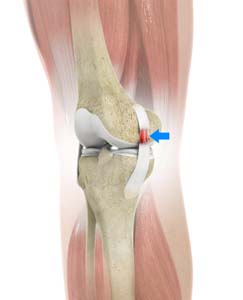
What is MCL?
The medial collateral ligament (MCL), a band of tissue present on the inside of your knee joint, connects your thighbone and shinbone (bone of your lower leg). The MCL maintains the integrity of the knee joint and prevents it from bending inward.
What are MCL Sprains?
Your MCL may get sprained or injured while twisting, bending or quickly changing direction. The sprain is classified into three degrees:
- First-degree sprain: Ligament fibers may be injured, but with no significant tear and no loss of integrity.
- Second-degree sprain: Not all ligament fibers are torn. Ligament remains intact overall.
- Third-degree sprain: Complete rupture of the ligament and loss of overall integrity.
What are the Causes of MCL Sprains?
MCL sprains occur due to a sudden impact from the outside of your knee, most commonly while playing sports such as rugby and football. Rarely, the MCL can get injured when the knee gets twisted or following a quick change in direction.
What are the Symptoms of MCL Sprains?
The symptoms of an MCL sprain include:
- Tenderness and pain in the inner side of the knee
- Swelling and bruising
- Stiffness of the knee
- Difficulty in walking
- Bleeding and inflow of fluid into the joint
How are MCL Sprains Diagnosed?
Your doctor will review your symptoms and medical history. Physical examination will be performed where your doctor checks the range-of-movement of your legs. An X-ray or MRI scan may be ordered to determine soft tissue injury, confirm the extent of damage and assess the integrity of your knee.
What is the Treatment for MCL Sprains?
MCL sprains are commonly treated by conservative procedures. You will be advised to take adequate rest and not strain yourself. An ice pack may be applied for 10 to 20 minutes for every 1 to 2 hours to reduce swelling. You may be prescribed anti-inflammatory medicines to reduce the pain and swelling. Your doctor may recommend crutches and braces to support, protect and limit movement in your knee. Rehabilitation procedures and exercises for MCL sprains generally focus on regaining knee range-of-motion, muscle control, and strength, and reduce swelling. Surgery is performed very rarely, in case of significant third-degree ligament injury.
Based on the extent of damage, your doctor will suggest the best possible treatment option to treat your MCL sprain.
For more information about our services or to schedule an appointment, call us at / / or cliAppointmentck here to request an appointment online. We’ll respond to you as soon as possible.