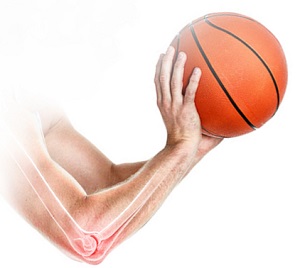
What are Throwing Injuries?
An athlete uses an overhand throw to achieve greater speed and distance. Repeated throwing in sports such as baseball and basketball can place a lot of stress on the joints of the arm, and lead to weakening and ultimately, injury to the structures in the elbow. These overuse injuries may include:
- Inflammation or tears of the ulnar collateral ligaments (supportive tissue that supports the elbow joint).
- Inflammation of the flexor tendons (tissue connecting muscles of the forearm to the upper arm bone) at the inner side of the elbow.
- Wearing of cartilage (spongy protective tissue lining bones in a joint) over the olecranon (pointed elbow bone) and development of abnormal bony growths (bone spurs).
- Tiny cracks (stress fractures) of the olecranon.
- Irritation of the ulnar nerve.
What are the Symptoms of Throwing Injuries?
Throwing injuries can produce pain, numbness, tingling, and reduction in the throwing velocity.
How are Throwing Injuries Diagnosed?
When you present with symptoms of a throwing injury, your doctor will review your medical history, discuss your athletic activities and perform a thorough physical examination to examine the strength, range of motion, and stability of your elbow. Imaging tests (X-ray, MRI, and CT scans) may be ordered to confirm the diagnosis.
What is the Treatment for Throwing Injuries?
Your doctor may suggest a conservative approach to treatment such as rest, ice application, physical therapy, anti-inflammatory medications, and a modification of activity and throwing technique. If symptoms remain uncontrolled surgery may be performed to repair the injured tissues either through open surgery or a less invasive technique (arthroscopy) where a camera and instruments are inserted through a narrow tube. Surgery may be performed to reconstruct the ulnar collateral ligament and relocate the ulnar nerve to the front of the elbow. Four to six weeks of rehabilitation is recommended following surgery to prevent stiffness and improve strength and range of motion. Your doctor will discuss when it safe for you to return to your activities based on the injury and how well you recover.
For more information about our services or to schedule an appointment, call us at / / or cliAppointmentck here to request an appointment online. We’ll respond to you as soon as possible.