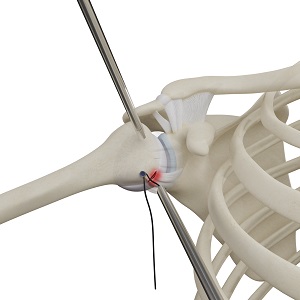
What is Repair of Humeral Ligamentous Tears?
Ligaments are soft tissue structures that attach one bone to another bone. Humeral ligaments are tough bands of tissue that connect shoulder bones and provide strength and stability to the shoulder joint. The key humeral ligaments are glenohumeral ligaments and transverse humeral ligament.
Glenohumeral ligaments consist of the superior, middle, and inferior ligaments. These 3 ligaments combine to form the glenohumeral joint capsule that connects the humerus to the glenoid cavity. Glenohumeral ligaments are the main source of stability for the shoulder joint. They help hold the shoulder in place and keep it from dislocating.
The transverse humeral ligament (also known as the Brodie ligament) is a small broad ligament that extends between the greater and lesser tubercles of the humerus superior to the epiphyseal line. It surrounds the tendon of the long head of the biceps brachii and its sheath in the bicipital groove, forming a tunnel thus preventing it from subluxing out of the groove during shoulder motion.
Strong forces can tear or rupture these humeral ligaments during traumatic injuries. Repair of humeral ligamentous tears refers to surgical procedures used to treat the rupture and restore normal shoulder joint function.
What is Anatomy of the Shoulder?
The shoulder joint, also referred to as the glenohumeral joint, is a ball-and-socket joint made up of three bones, namely the humerus (upper arm bone), scapula (shoulder blade), and clavicle. The head of the humerus articulates with the socket of the scapula called the glenoid cavity. The clavicle bone or collarbone is an S-shaped bone that connects the scapula to the sternum or breastbone. Tendons and ligaments around the shoulder joint provide strength and stability to the joint.
What are the Indications for Repair of Humeral Ligamentous Tears?
Humeral ligamentous tear repair is usually indicated for injuries such as shoulder sprain that have not responded to conservative treatment like rest and medications. A shoulder sprain occurs when the ligaments that support the shoulder bones overstretch or tear. It is a common injury and usually occurs when you fall or suddenly twist your shoulder.
What Does Preparation for Repair of Humeral Ligamentous Tears Involve?
Preparation for the repair of humeral ligamentous tears may involve the following steps:
- A review of your medical history and a physical examination to check for any medical issues that need to be addressed prior to surgery.
- You may need to undergo diagnostic tests such as blood work to help detect any abnormalities that could compromise the safety of the procedure. Diagnostic imaging such as an MRI scan may also be performed to assess the size of the tear, retraction of the ligaments, status of the attached muscles and tendons, and quality of the shoulder joint.
- You will be asked if you have allergies to medications, anesthesia, or latex.
- You should disclose your current medications or supplements you are taking, or any current illnesses or conditions you have such as heart or lung disease.
- You may be asked to stop taking certain medications, such as blood thinners or other supplements for a week or two.
- You should refrain from alcohol and tobacco at least a few days prior to surgery and several weeks after, as it can hinder the healing process.
- You should not consume any solids or liquids at least 8 hours prior to surgery.
- You should arrange for someone to drive you home after surgery.
- A signed informed consent form will be obtained from you after the pros and cons of the surgery has been explained.
What is the Procedure for Repair of Humeral Ligamentous Tears?
Repair of humeral ligamentous tears can be performed with two surgical approaches:
- Standard open surgery in which an incision is made over the anterior (front) of the shoulder.
- Minimally invasive arthroscopic surgery where small incisions on the shoulder joint are made followed by insertion of an arthroscope and instruments into the affected area.
Standard Open Surgery
In general, standard open surgery for repairing ruptured humeral ligaments involves the following steps:
- The procedure is performed under general and/or regional anesthesia with you lying either in a beach chair or lateral decubitus position.
- The skin around your shoulder is sterilized with an antiseptic solution, and an incision is made over the treatment area.
- The muscle overlying the shoulder is pulled aside with retractors to expose the torn glenohumeral ligaments or transverse humeral ligament.
- The torn ligament (s) is attached to its attachment site in the shoulder bone using small metal implants (called suture anchors or buttons) or stitched together using absorbable sutures to repair and reattach the ligaments.
- A final shoulder assessment is performed to confirm satisfactory repair, and the skin incision is closed and bandaged.
Arthroscopic Repair
In general, arthroscopic repair of a humeral ligamentous tear surgery will involve the following steps:
- The procedure is performed under general and/or regional anesthesia with you lying either in a beach chair or lateral decubitus position.
- Your surgeon makes a few small incisions (arthroscopic portals), about half-inch in length, over your shoulder joint.
- An arthroscope - a slender tubular device attached with a light and a small video camera at the end - is inserted through one of the incisions into your shoulder joint.
- The arthroscope transmits the image of the inside of your shoulder joint onto a television monitor for your surgeon to evaluate the ligamentous tear.
- Your surgeon then passes miniature surgical instruments through the other incisions and repairs the torn ligament. This involves bringing together the edges of the torn ligament and attaching it to the bone with suture anchors or stitching the two ends of the ligaments with absorbable sutures.
- A final shoulder assessment is performed to confirm satisfactory repair, the scope and the instruments are withdrawn, and the skin incisions are closed with a stitch or steri-strips (small adhesive strips) and covered with a bandage.
What Does Postoperative Care for Repair of Humeral Ligamentous Tears Involve?
In general, postoperative care and recovery after the repair of humeral ligamentous tears will involve the following steps:
- You will be transferred to the recovery area where your nurse will closely observe you for any allergic/anesthetic reactions and monitor your vital signs as you recover.
- Following the surgery, your arm will be placed in a shoulder sling for 2 to 4 weeks to rest the shoulder and promote healing.
- You may experience pain, swelling, and discomfort in the shoulder area. Pain and anti-inflammatory medications are provided as needed to address these.
- Antibiotics are also prescribed to address the risk of surgery-related infection.
- You may also apply ice packs on the shoulder area to help reduce swelling and pain.
- You are encouraged to walk as frequently as possible with assistance to prevent the risk of blood clot formation.
- Instructions on incision site care and bathing will be provided to keep the wound clean and dry.
- Refrain from strenuous activities and lifting heavy weights for at least a couple of months. A gradual increase in activities is recommended.
- An individualized physical therapy protocol will be designed to help strengthen your shoulder muscles and optimize shoulder function once you are off the sling.
- You will be able to resume your normal daily activities in 3 to 4 weeks, but with certain activity restrictions. Return to sports may take 6 months or longer.
- Refrain from driving until you are fully fit and receive your doctor’s consent.
- A periodic follow-up appointment will be scheduled to monitor your progress.
What are the Risks and Complications of Repair of Humeral Ligamentous Tears?
Repair of humeral ligamentous tear is a relatively safe procedure; however, as with any surgery, some risks and complications may occur, such as the following:
- Infection
- Re-tear
- Postoperative pain
- Bleeding or hematoma
- Damage to surrounding structures
- Stiffness or restricted motion
- Thromboembolism or blood clots
- Shoulder instability
- Adverse reactions to anesthesia/allergic reactions
For more information about our services or to schedule an appointment, call us at / / or cliAppointmentck here to request an appointment online. We’ll respond to you as soon as possible.